Saturday, June 29, 2013

A TALE OF TWO LEMON TREES (Citrus x meyeri) (Citrus jambhiri)


I have two lemon trees in my garden: a Meyer lemon (Citrus x meyeri) in the front yard that gives fruit in the autumn and winter and a Rough lemon (Citrus jambhiri) in the back yard that keeps me in fruit in the spring and summer.

Rough Lemon on left, Meyer Lemon on right, compared to a lemon from the supermarket.


The Meyer lemon I bought as a grafted tree and it produced fruit within a year. The fruit are huge and juicy and often grow in bunches.  Most years I expect about fifty fruit on my tree but a couple of times it has super produced so that I end up selling some.  The first time this happened was the year that Oahu had a noteworthy forty days of rain.  So....lemons like lots of water.  The second time this happened is this year. My tree is of course bigger now but there must be over a thousand young lemons on it right now.  I could not believe how the flowers kept coming out on the tree.  It may mean that I will have lots of little lemons instead of the usual big ones though.  So what do I think is causing the super fruiting this year?   Well we have had fairly good rain this spring, but the other difference is that I moved about a dozen pots of young red ginger plants under the tree to give them some protection from sun and wind.  Maybe it is because the tree is getting more consistent watering because I have to water the gingers in the pots.  Maybe there is a regular feeding coming from the pots too as the fertilizer in them leaches down into the rooting zone of the lemon tree.  If I get such good results again next year I will know I have really hit on a good thing.

Immature Meyer lemons


My Meyer lemon in the front yard


Another problem I get in the Meyer lemon tree is aphids on the new growth.  As soon as I see them I look for ant nests that they build within the bunches of fruit and blast them out with the water hose.  It is the ants that bring in the aphids like herds of cows...to milk them of their sweet body fluids.


The Rough lemon in the back yard we usually call by the Samoan name, Tipolo Pakupaku as I first got to know of this lemon in Samoa.  It is a popular lemon in many islands of the South Pacific, not only for its fruit, but also for its very fragrant leaves that are used in making tea or added to desserts along with coconut milk.  The  large bumpy fruit of the tree does not keep well when picked so I leave them on the tree until I need them.

Our Rough lemon I grew from seed so it was several years before the tree was old enough to fruit. It is a very tough thing with big thorns.  It grows in the very sandy back yard with the full force of the salt winds from the beach about 300 yards away.  I am afraid it is a rather sad looking tree because of that with about half of the tree covered with dead branches because of the salt wind.  I leave them there as a wind break for the rest of the tree.  Because the Rough lemon is such a tough tree, is is used as rooting stock for grafting in many parts of the world.

My poor windblown  Jambhiri Lemon tree in the back yard


I expect my uses for lemon are much the same as yours so I really cannot think of any exceptional way of using them.  I like squeezing lemon juice in my ice tea, on my breakfast papaya, and on salads and fish etc.  You can freeze lemon juice in ice trays and then bag the juice cubes to freeze for future use, although my two trees keep me supplied all year.  Home made lemonade is just right on a hot summer day and if you want something really special, try adding  a bit of ginger root tea to the lemonade.  The leaves of the Rough lemon make a beautiful tea so that is worth trying.
Immature Jambhiri Lemons


As an end note, I also want to comment on how the two lemon trees are part of nature in our little part of the world.  Both of the lemon trees get lots of visits from the Citrus Swallowtail butterfly which I enjoy seeing in the garden and I do not see any damage to the tree from them.  The two trees are also very popular for nest building by the little red wax billed rice birds.  There are several of their tunnel door nests in the trees and they will add on to them the next year.  I am glad that they find needed protection in my loved lemon trees.

Aloha

PS   February, 2015
Well I am still getting lots of flowers and lemons on my Meyer Lemon tree so I have decided that having the several pots of newly propagated ginger kept under the lemon tree is really giving the tree a boost with the constant water and fertilizer from the pot plants going to the lemon tree as well.  Last week I had another surprise in my lemon tree too.....have a look at this photo!


Yep....this is a huge swarm of honey bees that showed up.  It was at least two feet long. The whole thing is just made up of bees surrounding their queen bee. They have split off from a hive and are looking for a new home.  A bee man was very happy to come and get them to build up his hives.  It all caused quite a bit of excitement around here!

PS July, 2016
I am very sorry to have to tell you that my Rough Lemon tree has died.   It has always had a tough life out in the back yard because of sandy soils and salt winds coming off the ocean.  Last year it was hit by really big winds a few months before Christmas which left the tree almost naked but it grew new leaves in and still looked good.  Then a few months after Christmas we had another big salt wind session and the tree just did not have the energy to grow new leaves all over again and has died.  I will miss my source of lemons in the spring time so I guess I will be freezing lemon juice from the Meyer Lemon to keep me going in between seasons.  I have also  grown several baby Rough Lemon trees from the seed so hopefully there will be more fruit in the future.

August, 2017
Rough lemon number two is now growing out in my back yard and big enough to at least provide fragrant leaves for tea making even though it will be five years or so before I get some fruit.  This time I have planted the tree closer to the crown flower tree for protection from the salt winds.  I have been trimming the crown flower tree to grow out on one side to give more protection.


June 2022
Well, this year something really strange has happened with my Meyer Lemon.  It just dropped all its tiny little fruit while I was away traveling a few months ago and so I have a total of 4 fruit on the tree when usually it is loaded with hundreds!  The tree must be at least 20 years old and every year I am giving bags of lemons to all the neighbors but this year they will not be getting any.  It has been an extra dry winter for us and I think the tree just decided it was going to take a holiday this year. Plus there was a big salt wind event while I was away.  That is me being positive.  Hopefully the tree is not on the way out.  At least my Rough Lemon in the back yard is now producing so I do at least have a few lemons to keep me going.  I carefully freeze lemon juice in ice trays so that I have a continual supply of lemon juice to put in my afternoon iced tea and each lemon is not wasted.

August 2026
The Meyer Lemon had another small crop in 2024 but really good last year in 2025.  It has been getting some special attention beside the usual fertilizer and watering.  This included Epsom salt and banana skin tea.  However this year there is another problem with the tree.  Only half of the tree is producing while the other half just has a few leaves left and lots of dead branches.  Even the good side was very slow in producing flowers and fruit but got into full gear after the front yard was under several inches of water from this springs Kona Low storm.  Only now are the fruit starting to get some yellow in them and are usable when usually I can start using them in late June.  The tree is getting very old at this point so I am grateful to still have lemons.


 The Rough Lemon in the back yard is still producing some too.  The back yard area is actually owned by someone else and we just used it.  In 2023 they cleared the land ready for building houses , including my beloved crown flower and breadfruit trees, and this allowed the Lemon tree to get the full onslaught of the salty sea breezes so that it almost died.  Now the houses are still to be built and the rubbish trees and tall grasses have grown back up to protect the tree again.  After the Kona Low super rains the tree sprung back into life and is now covered with leaves and has given off a few more lemons.  It does show that lemon trees really like water, especially in our sandy soils.  Lots of lemons might mean a very high water bill if there is not enough rain.

Tuesday, June 4, 2013

Garden Notes From Israel


I have been off traveling again.  This year my exploring trip was five weeks of traveling around Israel.  This included two weeks in Jerusalem which is so packed with things to see.  As usual, I was taking an interest in all things to do with garden and agriculture.  The northern two thirds of the country, with its Mediterranean climate, has much more agriculture, but there was a lot going on in the dry rocky desert areas of the south as well through the miracle of drip irrigation.  I found out that it was Israel that actually developed drip irrigation and gave it to the world.  Cherry tomatoes were apparently also a gift to the world from Israel.  All of us that live in the tropical world really appreciate that.  They are so much easier to grow in our climate.

I, of course, expected to see things like olive trees, dates, pomegranates and wheat growing in Israel but the amount of agriculture in the country was just astounding.  When I went to the markets and asked where the produce came from the answer was always, "Here in Israel"  They put Hawaii to shame.  It is estimated that about 85% of our food here in Hawaii is shipped in from outside the state.  I loved the real tasting nectarines in Israel and they had a lovely small skinny cucumber that was really nice too. It is the first country I have ever been to that always has a fresh salad as part of breakfast.  Tomatoes and cucumbers were always part of that.  I was surprised to see the amount of bananas being grown in the country.  Huge fields of the crop and most often grown under huge net covers to keep out the birds and insects.

A few places I saw a Hawaiian friend which always gives me a little thrill. These were tough native Hawaiian plants that were used in public gardens under hot dry conditions.  Just showing that they can handle it with a bit of that drip irrigation.  This included the shrubs Hau 'Ula, 'A'ali'i  and  'Akulikuli as a ground cover.  These plants are native to Hawaii but also have a wider presence in the Pacific.

A usual I was taking photos of gardens as I traveled around and I will share a few of them with you to give you a feeling of the country and maybe they will give you a few ideas for your own garden.

Aloha


Saturday, March 23, 2013

Samoan Food Gardens


I was getting prepared to write a new post for this blog when I suddenly had to go to Samoa for a week.  So instead of talking about a plant this month I will put up a few more travel pictures.  I thought you would like to see a few views of food gardens near where I stayed in Samoa.  In the Samoan traditional way of growing, crops are mixed up together in a much more natural way .....you know, like we gardeners in western countries are just learning about in permaculture.  Being a hot, rainy, tropical island in the South Pacific, Samoa has very lush green gardens.  Of course the weeds and diseases can grow really well too.  So do the invasive African snails who love those lush green leafy vegetables.

I love walking around Samoan plantations and food gardens.  To me it has the awe and peace of a sacred place as I walk along dirt paths through all the tropical growth.  Maybe you will get a feel for the place too as you look at these photos.  The plants shown include:  Taro, Sugar Cane,  Pineapple, Eggplant, Lemon Grass, Lau Pele (an edible hibiscus leaf) as well as the fruit trees......Papaya (Paw Paw) Breadfruit, Citrus and Bananas.


 Aloha


Tuesday, February 19, 2013

PURSLANE ( Portulaca olearacea )


It has taken awhile for me to get around to thinking of Purslane (or Pigweed as we call it in Hawaii) as a vegetable.  I have known it was edible for many years, even that it was high in Omega 3, but I have gone on thinking of it as a survival food weed that shows up in my garden in the spring.  After seeing it being sold at the market on Corfu, in Greece, I looked at it with a little more interest and even more so after seeing it being grown in Jordan a few years ago.  The final push was when I recently saw that the local Hawaii gourmet greens grower was selling Puslane at the farmers market.  That was when the cheap me thought "Heck, I could grow it for free"

So finally Purslane has become a regular vegetable in my diet.  I toss it into salads and sandwiches and it is really nice with a bit of rice and wrapped in a piece of nori....like a roughly made sushi.  Not only is it providing cheap me a free green vegetable but it is saving me from buying Omega 3 supplements.  I also like it in a yogurt and cucumber salad while some people prefer to saute their Purslane.

Rather than harvest from the back yard lawn, I pulled up one healthy Purslane plant and potted it up to keep in my container herbs area.  It grew huge and got lots of yellow flowers that seeded into the pot.  When I pulled out the old mother plant, hundreds of little plants came up and I have decided to treat them as micro greens.  I just trim the tops of the Puslane off with scissors to harvest it for my salad.


Puslane is loaded with nutrients.  It is high in vitamins A and C.  It is also has the highest amount of Omega 3 of any leafy green vegetable.  It does however, have a high amount of oxalic acid so not so good for people who get kidney stones.  The plant is originally from India but has now spread around the world.  It is a popular leafy vegetable in many countries such as Greece, Mexico, India, and throughout the Middle East. Note that these countries all have a drier climate so this is a tough plant.

In Aqaba, Jordan, the town had a community vegetable garden in a long strip of land between the town center and the beach.  I suspect that it once may have been a promenade park but has now been put to a much better use and still provides a restful green belt for the town.  The gardener/farmers were looking after small table size plots that were edged by dirt ridges and tiny irrigation ditches.  Just like irrigated fields in miniature.  Here Purslane and other vegetables were being grown.  The harvested vegetables were pushed up to the nearby town market on wheel barrows where the barrows now served as vender tables. I thought the whole system just wonderful and will add a few photos of the setup in in Jordan for you to see.


Aloha

PS

Some time has passed since I wrote this post on Purslane.  The "letting it grow and cut with scissors" has not worked out in the long run as the pot gets too crowded and the leaves get too tiny as a result so I have made some adjustments...and when I look at the Jordan pictures again....it may be similar to how they are harvesting it there too except for the thinning out.  First I need seeds, so I can gather them from wild Purslane or just grow one or two plants in the pot until they are mature and their seeds drop into the pot.  Then I let the seeds grow but when then get about half and inch high I pull most of the seedlings out and leave maybe a few dozen to grow.  In a few more days they are 3"-4" high and are ready to be harvested by just pulling them out.....roots and all.


  I rinse the dirt of the roots and leave the seedlings in a cup of water to keep them fresh until use later that day.  I love the leaves in egg or tuna sandwiches. Usually there are still plenty more seeds in the pot so that more will be coming up within a few days and I start the whole process again.  This just gives me small amounts from my small pot so if you wanted large amounts you might need a big tray sort of container to grow them in.  One of my beach find fish boxes would work well for that.


PS  April 2020
I have been spending time surfing around in the internet. Like most people, I am isolating at home during the corona virus pandemic.  Anyways....I came across an article about edible flowers, and they said that Purslane flowers are as good to eat as the leaves.  You could pop a few flowers on top of your salad to make it more interesting.

June 2022
Just adding a picture of my current tub of purslane.  the tub stood empty while I was away traveling and lots of Purslane volunteers popped up giving me a big supply.  I am always throwing leaves into a mixed green salad, and I always add the leaves to a tuna fish sandwich.


November, 2022

I am including a photo of Purslane on sale at the farmers market at Ostia Lido, Italy taken last month.  I noticed that the empty lots and uncared for public parks were full of lush Purslane growing wild, so I suspected that is where it came from rather than farms.


Thursday, January 31, 2013

DRAGON FRUIT / PITAYA (Hylocereus undatus)


I first came across Dragon Fruit several years ago while exploring a street market in Hong Kong.  I had never even heard of them, so the sight of these bright colored, dramatic looking, fruit was rather mind blowing.  I bought one to try out back at the hostel.  It tasted a bit bland so I was not so excited about the fruit after that.  A few years later, while in Thailand, I came across a lady selling fruit juices from a little table in the street.  She was using the red fleshed Dragon Fruit to make juice.  The red flesh gave the juice a dramatic purple color and it tasted wonderful.  That was when I became a fan of Dragon Fruit.


The juice seller was just cutting the fruit in half and scooping out the flesh., She then dropped the chopped pieces of flesh into a blender.  It gives lots of vitamin C and minerals.  Those little black seeds throughout the fruit flesh provide lots of fiber.  In the last few years Dragon Fruit has become known on the world markets.  The supermarket in our little town is even selling it now.  The fruit comes from farmers growing it on the "Big Island" of Hawaii.  Farmers like it as a crop that can put up with occasional water shortages.  I see Pitaya Bowls for sale from food trucks along the north shore surf breaks.  I think the name Pitaya is the name given to Dragon Fruit in South America where it is popular with the surfers there too.

The Dragon Fruit is a type of cactus, native to Mexico, Central and South America.  It has large white fragrant flowers that bloom for one night.  It is related to the night blooming Ceres cactus that is grown here in Hawaii on old rock walls for its beautiful flowers but does not have the fruit. The fruit is usually the bright pink skin with white flesh but there a two other species also called Dragon Fruit.....that is the pink skin with dark red flesh type, and the yellow skin with white flesh type.  The fruit is ripe 30-50 days after pollination when  the green spikes on the fruit are not so green colored and there is a slight softness to the fruit.  It is best to leave the fruit to soften up a bit for a day or two after picking.

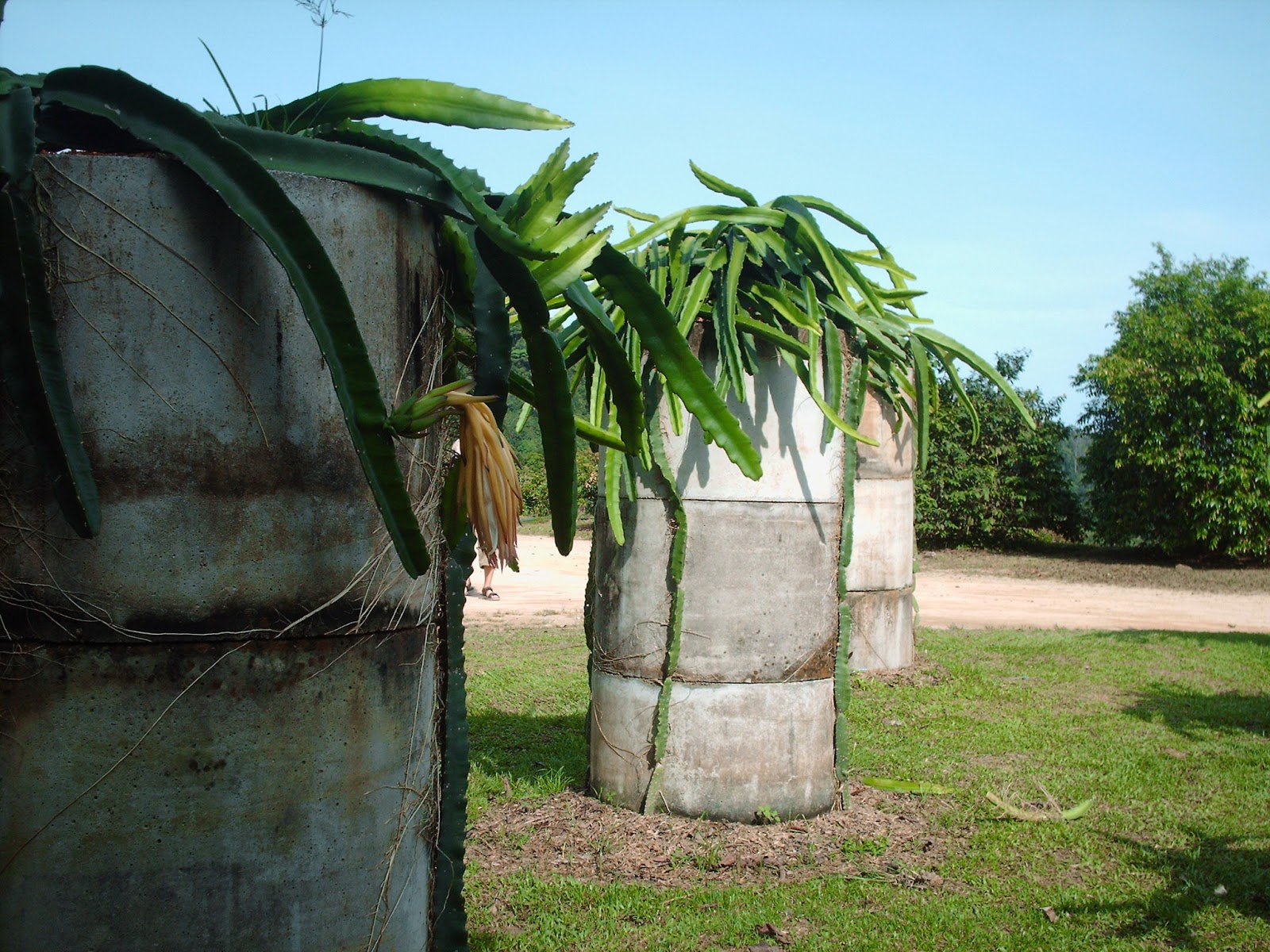
Although the Dragon Fruit plant will naturally grow up walls and trees, it is usually grown on farms on strong cement posts several feet high.  The thick stems of the plant grow roots from their surface to attach to the support post. Once the plant has grown to the top of the post it will hang down over....so that the plant looks rather umbrella in shape. The early growth can be cut back at the top of the post to encourage a bigger growth of "umbrella spokes"   It is from the end of these hanging branches that the fruit grows.  The plant will start fruiting when it is about 10 pounds in weight.  It can be grown at home in a large container but you will need a strong fence or railing for it to grow up.   I have mine growing up an old coconut stump that is about 5 feet high. For good strong production of fruit you need a second plant for cross fertilization.  It is rather a poky plant, not something to grow next to walkways.

The Dragon Fruit plant needs plenty of sunlight and very good soil drainage.  Do not over water this plant. It does not like acid soils but that is not a problem in my coral sand soils.  It likes low nitrogen and high phosphorus levels.  Farmers fertilize them about every two months.  Dragon Fruit plants can be grown from seed but it is very easy to grow from cuttings.  Place cuttings in potting mix and water just very occasionally so that the soil can dry out between waterings.  The piece of stalk will first grow roots and then grow arms. 

Last year I saw Dragon Fruit growing at the Tropical Fruit Farm on Penang, Malaysia.  I really liked the way they were growing theirs so I will finish off with a photo showing their technique.  They had four plants growing up stacked large round cement pipes.  Into the center of the cement pipes they were throwing their compost to feed the plant roots.  Maybe it will give you some ideas for your garden.


Aloha

PS   August, 2015

A few weeks ago we had great excitement in the back yard under a beautiful full moon.  Friends and family were over to see the first blooming of two huge, dinner plate size, flowers on my Dragon Fruit plants.  The stunningly beautiful flowers only open at night and only for one night.  It looks hopeful that the moths did their pollination work because the flower bases are now swelling in size and I should be able to eat the fruit within a few weeks.  There are also some more tiny flower buds coming out on another arm of the plant.

My Dragon Fruit plants are rather neglected.  They grow on a four foot high coconut tree stump which also has my washing line attached to it.  The plant is rather ugly and spiny so that I have to keep it cut back from the hanging washing and I have often thought that maybe it is better to get rid of the plant.  I grew it in the first place because it was something exotic that I knew nothing about and just wanted to learn about it.  It has rather redeemed itself with its beautiful  flower showing so I will give it at least another year of observation and if the fruiting goes well it will get to stay.  Here are some photos of the fruiting process in the past few weeks and I will add more until they are ready for harvest.


New flower buds coming out....one of these later died off.
Flower buds that are several inches long and grew by a few inches every day.
The flowers opening at night.
The flowers closing up the next morning.
The flower ovary fattening up as the flowers die off.


Sunday, December 16, 2012

PINEAPPLE (Ananas comosus)


Pineapple is a fun plant to have in the tropical garden. The young children like to watch the fruits growing at an easy eye level.  I got into it several years ago when some free pineapple plants in pots came my way.  Giveaways from an elderly gentleman who could no longer look after them. Thank you.  At first I thought I should plant them out in my garden.  Within a few months I realized that I had done the wrong thing.  Out of sight and planted in our coral sand soil, they were dying from neglect.  I managed to save a few and planted them into a big old rusty tub that I picked up along the road from some some body's rubbish pile.  The tub of pineapples hangs out amongst the containers of herbs and makes a nice contrast to the little leaf green plants.  Every few years we harvest a few pineapples from it so I guess it is more for fun than for food supply.


The type of pineapple I have is sweet and very white fleshed.  I am guessing that it is what is locally called "Kona White" variety.  It has reddish leaves.  Dole Pineapple company used to have a display of different varieties of pineapple up at an intersection of the road near Wahiawa in their pineapple fields. We used to love stopping by with our visitors as part of our North Shore tour.  We would always look for our favorite-- the Samoan variety with red leaves.  The sweetest pineapple I know grow in Samoa.  Now that the fruit canneries have closed down in Hawaii, there are a lot more sweeter varieties being grown here for serving fresh at the table.  e.g. Maui Gold.

Pineapples are in the Bromeliad family which will grow in tree branches and rocky places so are a fairly tough plant.  They have a small root system so actually do well growing in pots.  I have seen them looking healthy in little pockets of soil in lava field gardens in Samoa.  I have three plants clumped a foot apart in the old tub.  They are mainly growing in old wood chip compost and soil that I add to occasionally.  They are growing in full sun and get a bit of fertilizer.  The main thing about growing pineapples is that they hate wet feet.  They like rain but must have good drainage.  They do grow very long and sharp pointed leaves so you need to give them some private space.  Some gardeners like to grow them inside old tires.

It is fairly easy to get new plants going from the pineapple you buy at the grocery store. Just twist the top off your pineapple.  I have found that the tops grow better if they have not been stored in the refrigerator so twist the top off before cooling the fruit for eating.  You also need to remove any remaining fruit flesh on the top, if you cut the top off, and also pull a few layers of the small leaves off the bottom to expose a bit more of the stem.  The usual problem in growing pineapples is that the leaves turn black.  The plant has rotted and died..  To prevent this you just need to leave the cleaned pineapple top on a bench for a week to dry out.  Once the stump has dried out you then can plant it in some loose potting mix in a 6 inch size pot and let it get rooted there before planting it out or into a bigger container.  Some people swear by putting the pineapple top in a glass of water to grow first.  Make sure to change the water every few days and once the roots start showing, get it planted.

It will take two  years before you will harvest your first fruit.  Like all Bromeliads, the mother plant will die after fruiting but will give off some suckers/keiki first.  If you leave these in place these suckers may produce more fruit in a years time.  The pineapple plantations pull up the plant after the second crop and grow new plants again from the suckers and tops.

I am trying to think of food ideas with pineapples.  mmmm  I guess it is all the usual stuff that everybody knows.  We just usually cut them up and eat them fresh.  If serving them at a party, the sliced fruit always looks nice with a piece of green banana or ti leaf placed under it on the plate.  It has become popular in the last few years in Hawaii to serve fresh pineapple sprinkled with salty Ling Mui powder that comes from China.

Aloha


Tuesday, October 23, 2012

TIARE (Gardenia taitensis)


I realized that I needed to grow a Tiare bush (also known as Tahitian Gardenia) in my garden when my daughter was needing Tiare flowers to put in her hair on her wedding day.  We ended up finding them in a Tahitian friend's garden.

I knew, from earlier experience, that getting Tiare plants growing from cuttings is very hit and miss.  Maybe only one in twenty cuttings would grow roots for me.  I also knew of a Tiare bush that had big golf ball sized, seed filled, fruit on it, so thought I would have a go at growing Tiare from seed.  I gathered a couple of yellowish colored fruits and left them for a few weeks on the windowsill to ripen up to a squishy orange.  There are many seeds in the fruit and so I got a whole tray full of seedlings from the experiment.  As I transplanted them and re potted them, I found them to be quite hardy and forgiving of lack of care when I was away.  I planted one of the babies in my garden where it is now a very healthy bush supplying me with lots of flowers despite being in a place where it gets our salt winds.  It does get well watered though from the down pipe run off from the neighbor's roof.


The Tiare bush can grow as high as 12 feet high but most people keep them trimmed down lower for easy flower picking.  They have wonderful large glossy green leaves that show off the pure white flowers.  Leaves do tend to turn yellow and drop off if they do not get enough water though.  The flowers are very fragrant.  In Tahiti, where it is the national flower, the flowers are used to perfume coconut oil to make body oils.  The flowers look so beautiful tucked up in a woman's hair or strung into a lei.  All the hotel resorts in French Polynesia greet their guests with Tiare leis.  A Tiare flower was even given to me as I went through immigration on arrival in Tahiti.  (Hawaii immigration take note!)  The Tiare flowers are also put to use to freshen the air in restrooms throughout the islands.   Party or hotel hosts have an attractive small arrangement of Tiare by the sinks to greet guests using the toilets.


Many new comers to Hawaii get excited about being able to now grow tropical flowers.  The first one they all seem to want to grow is the Gardenia.  If they are growing it our part of the island they will find that over several months their new plant just dies.  The leaves will turn yellow and get covered in sooty mold and aphids.  This is because Gardenias need rich soil to grow and in our town the soil is mainly composed of coral sand....high in calcium and low in iron.  However, this is just the sort of soil that  the Tiare is happy to grow in.  They will also tolerate salt winds too although I am not sure I would put it right on the beach.  It does need plenty of water to be healthy and produce lots of leaves and flowers.  So if you have sandy soils you can still grow Gardenias.....only it is the Tahitian Gardenia.

The Tahitian Tiare is well known throughout the Pacific Islands but some of the islands have their own form of Tiare. eg. the Cook Islands.  Even here in Hawaii, we have the Na'u which is a Hawaiian species of Tiare.  Only now is it starting to show up in nurseries and gardens as it is being brought back from the brink of extinction.  It is thought by some that the Hawaiian and Tahitian Tiares were all canoe plants taken out to the Pacific Islands by the Polynesians.  A lot of attention is shown to canoe plants like Taro and Breadfruit but I am willing to guess that those Polynesian women going out on the voyaging canoes were wanting to take their favorite lei flowers as well.


The usual form of Tiare flower has seven petals and this is the form shown on Tahiti print fabrics etc. but it can actually have anywhere between five to nine petals.  While I was traveling in French Polynesia last year I found myself counting Tiare petals everywhere I went.  I found that on Tahiti island the flower was usually seven petaled but up on Bora Bora most of the Tiare had six petals.  A few years ago I gave my daughter three of the young Tiare bushes I had grown from seed.  They now make a nice show in front of her house.  Of these three shrubs, all give seven petaled flowers but one will sometime throw out an eight or nine petal flower and another will sometimes give a six petal flower.  The third shrub is absolutely loaded with  Tiare fruits although the other two never have any.  I am thrilled to know I have a source of future Tiare seeds as Tiare fruits are hard to find although I have never been able to figure out why.  I think that the three plants all being grown from seed has helped them all be a bit alternative.....on the other hand the one in my garden, that was from the same lot, is completely normal.

I hope I have sold you on another one of my favorite hardy and useful plants to have in the garden.  I love my Tiare bush that is growing next to where I park my car.  As I head out to a baby birthday luau or a wedding reception, I will pluck a Tiare flower to tuck behind my ear to feel a little more festive for the occasion.

Aloha