Saturday, May 27, 2017

WALKING AROUND BELL BLOCK, NEW ZEALAND


I have just recently had three weeks in New Zealand, visiting family and doing some exploring as well.   Bell Block is a historic community in north Taranaki and now mostly is a suburb of New Plymouth.  Here are just a few garden related shots as I was walking around that may be of interest to you.


Not a garden shot but all this produce is from a Bell Block garden.  


While in New Zealand I found a fun gardeners book while looking around a thrift shop.  It is written by a Kiwi landscape architect about her small Wellington garden.  "Life (and death) in a Small City Garden"  by Philippa Swan.  I am writing out a few paragraphs from her book.....see if you recognize yourself.  ☺

 Real Gardeners are a breed of their own.  I'm sure they have a bent chromosome or something which accounts for their eccentric behavior.  A Real Gardener always sleeps badly on a windy night--even when they are in Bali, and their holiday snaps are of the bushes flowering around the swimming pool.  Their first question on ringing home is always about the weather................... A group of gardening ladies is a nightmare at the pictures, especially when it's a Merchant Ivory period drama with lots of roses and wisteria.  A chorus of plant names erupts every time a bloom appears, followed by a messy dispute at to what sort it was and who's got one at home.

Gardeners have a unique navigational system.  When being directed to their house, you will be issued with instructions like, "Turn left at the red-flowering gum tree and we're three doors down from the dogwood."   ..................When a gardener comes for dinner they do things like check whether your magnolia-patterned curtains are anatomically correct and stuff the garnish from the French rack of lamb into their handbag because they've never grown pizza thyme before.  When they go collecting for charity they arrive back with a collection bag full of cuttings, and their consumer choices at the supermarket are made on the basis of what comes in a container most suitable for potting up the hosta seedlings.  Gardeners are never happier than when a friend arrives with a bag of smelly old panty hose.

Aloha

Wednesday, April 12, 2017

SURINAM CHERRY (Eugenia uniflora)


In the front windy and dry corner of the garden, where the soil is mostly coral sand, I have a small waist high Surinam Cherry shrub that I planted a few years ago.  I must admit that I did not have big expectations for it there.  It was mainly a shrub to help fill in the corner and, if I was lucky, I would get a few fruit.  A week ago, one of my grand-daughters took me over to the corner to look at something.  Guess what!  The whole small tree was covered with small, pale green jewels.


A month or so back we had a big rain storm and it must have sent the Surinam Cherry into full reproduction mode.  I may have thrown a bit of fertilizer around too at about the same time.  The Cherry tree would have become covered in lots of small white flowers and now here is the fruit just starting to ripen up.

Every morning I go pick the newly ripening fruit before the birds and wild chickens get them and leave the fruit on the kitchen counter to ripen for the rest of the day.  I will have a few to eat fresh but mostly I am collecting them in the fridge until I have a pot full to cook up.  It is just a matter of bringing the fruit and some sugar to the boil and then leaving it to simmer for a few minutes....just like making apple sauce.  You also need to remove the cherry pits after the cooking.  The resulting sweet/sour sauce is fabulous over vanilla ice cream. I imagine some inventive person could also make a relish or chutney out of it that would go well with meat. Some of the fresh fruit I will freeze for future smoothies.... after removing the seeds.  The beautiful jewel like fruit look beautiful as a decorative topping on desserts.  I have also seen the ruby red fruit used in breathtakingly beautiful flower arrangements.


As you can guess from its name, Surinam Cherry is native to the NE coast of South America.  It is a tough evergreen shrub that can grow up to 10 feet tall.  The small leaves have a spicy scent and coppery colored new growth.  Its growth habits make it good for hedges.  The Surinam Cherry tends to flush into flower after heavy spring and fall rains.  The 1" round and ribbed fruit are usually dark red when ripe but there is a black variety. The fruit is on the sour side but kids always love to pick and eat the cherries out in the garden. The fruit fly can bother the fruit but so far I have not had any problem with them.  Maybe picking the fruit before fully ripe has helped prevent this.  Surinam Cherry is easy to grow from seed although the resulting little tree is a slow grower.

Aloha

Tuesday, March 21, 2017

SANSEVIERIA (Sansevieria trifasciata)


I have mixed feelings about the plant that is my topic this month.  I can always be grateful for a tough plant that will grow in dry, sandy areas.  On the other hand, Sansevieria can get a little out of hand in the garden and start spreading too far or get rather messy looking.  Good strong borders such as a cement path can help keep it in check.  The good attribute that won me over is that Sansevieria is a fabulous indoor plant.  In fact it is usually rated as the easiest indoor plant to care for.  Besides that, it is a very good oxygen provider for enclosed spaces.  It can become a win-win solution if you keep the outside plants trimmed back and pot up the trimmings for inside the house.


Sansevieria is native to tropical West Africa.  It has thick succulent leaves and sometimes it will give out small greenish white flowers on stalks in summer.  There are lots of varieties although most people will recognize the tall lance like leaves of the "Mother-in-law's tongue.  I have a green and a yellow leaf form of this.  I also have a green dwarf rosette type or "Bird nest"  Be aware that the leaves are poisonous to animals.  Sansevieria needs good drainage so go easy on watering your indoor plant.

To get Sansevieria cuttings for potting is is easy to see new baby plants growing out from the mother plant on fat finger size stolons.  Cut off a few of these, making sure that you have some root attached.  Usually I will let the cutting scar dry off for a day before I pot them up.  Three arranged together in a pot looks nicely balanced.  After growing for several months, a potted plant can get very root bound or the strong roots will even break the pot.  You may need to just throw away the plant if it gets too rambunctious and start a new one or severely chop back the roots and repot.


Aloha

March, 2022

A photo of a new Sansevieria with thin leaves in my garden.  I bought it about a year ago as a much smaller plant, but I think it is getting big enough to take off a few stalks to get a new pot going.  I had to swallow my frugal instincts to buy the plant but it was worth getting a new type and I have not seen them being sold since.


Wednesday, February 1, 2017

PORTUGUESE CABBAGE (Brassica oleracea var. costata)


This is just going to be a quick post today but I am excited to introduce a new plant in my garden.  For the first time ever, I saw Portuguese Cabbage starts at Koolau Farmer's nursery about a month ago.  I only heard about this cabbage for the first time a few years ago.  It was an important vegetable in gardens of Portuguese workers on the sugar plantations here in Hawaii. They called it Couves.  I am thrilled to actually see what it looks like and to have a go at growing it.  After only a month of growing this single plant I am already a fan so this is why I wanted to write about it today.   Have a look at the picture.  It is a very sturdy plant and a no fuss one.  There has been a bit of leaf miner in the old leaves but I just remove them.  The plant is very similar to collard greens and apparently grows the same way......the stem just getting taller and will keep going all year long.  I have already had a few leaves in a stir fry and I look forward to just picking leaves off as needed and having a constant supply.  This is a picture of a young plant and hopefully I will be able to put up some pictures of the mature plant later on.  You can check back for later reports.


In Portugal it is an important vegetable used in national dishes.  It will work good in your Portuguese bean soup or in a stir fry or coleslaw.  It can be grown from seed but apparently you can cut the head of the stalk off , remove most of the leaves and plant that up too.  I expect the stalk then grows a few more heads....just like collard greens.  Anyways, I did want to share my excitement about this plant and maybe it is something new for you to try as well.

Aloha

PS
A month and a half latter and the plant is still surviving.  The leaf miner has not been bothering lately but those tiny round snails have to be watched for.  I also get a few white fly hanging around under the leaves so I have a habit of tapping the leaves underneath as I walk by to make things too uncomfortable for them.  One leaf is a serving for one person.  I love it in a coleslaw with grated carrot and green onion.

July 2017
Well my Portuguese Cabbage is still alive  after five months and I am still enjoying a few leaves from it every week.  It is now a head  of leaves on a stalk.  The white cabbage butterfly have become interested in it so I keep it covered with a bit of netting made from the net bag I bought some avocados in.  It does seem to discourage the butterflies but it may just be that they are now more attracted to my neighbors cabbages.


July 2018
Well, the cabbage is still alive but seems to get lots of aphids attacking it.....I try to remember to shoot the leaves with the hose when I am watering to make it less attractive to them.  The stalk has become at least 4 ft tall now and is leaning over a bit so that I have propped it up a bit so that the plant does not pull out of the ground.  Now I have a new development.....a few baby cabbage heads growing out of the stalk.  Maybe I could chop the top off and let it become a multi headed plant, or maybe I can cut these mini heads off and grow new plants from them.....I think I will try that first.  Maybe that is how the grower got my original plant growing  rather than by seed which is what I would have expected.


Nov. 2018
Well, I made a bad move....the cabbage plant was getting so tall and leaning over so much that I decided to cut the top two thirds off before I went on a trip.  Came back a month latter to find it dead.  Not sure if it died because of stress or because of so much rain that got in the stem and made it rot.  Maybe next time I should put a tin can over the stump like they suggest when cutting papaya trees so that rain does not get into the trunk.  I did get a few of the babies going that I cut off and planted up.

Saturday, December 31, 2016

HAWAII MOCK ORANGE (Murraya paniculata)


Mock Orange is a small tree that gets ignored by visitors to Hawaii as it is rather plain with small green leaves.  Add that is is usually used in hedges and it really falls below the tourist radar.  It is only when it is in flower for a few weeks in the fall that it gets noticed.  Then there is a strong fragrance wafting in the air as you walk or drive down the road and you turn your head to see where the perfume is coming from.  The small leaves of the Mock Orange are also popular with lei makers in Hawaii as the long lasting leaves are often threaded between flowers for some green contrast color in a lei.  It really goes well with the flowers of my crown flower tree.  I have one Mock Orange tree tucked up into a mixed shrub hedge that keeps me supplied for lei making.  The small Mock Orange flowers are beautiful but do not last well for flower arrangements and some find the fragrance too strong in the house.  You might not want to plant a Mock Orange too close to a house window for the same reason.


Mostly Mock Orange is used in Hawaii for forming hedges along the road front and can grow thick and high.  They are easily trimmed and shaped. Sometimes they get used for topiary. There are quite a few Mock Orange hedges in my community.  Several months ago, one very tall and wide hedge got a very severe cut back so that it was mainly bare sticks remaining.  I wondered whether the hedge would be able to recover.  I had a look at it a few days ago and took the picture below.  As you can see, it is coming back strong and in several more months should be really thick again.  Tough trees!

Photo taken December 2016
Inserting another photo in here a year later so you can see how the hedge above looked a year later.  I was very impressed with how tolerant the trees were to the hard pruning and how fabulous it looks now.

Same hedge, December 2017


There is another smaller and lower Mock Orange hedge in town that I walk by on a regular basis.  This one has some problems and one of them is the salt winds that come down the street.


However, the main problem is the way the hedge has been cut over the years.  It has developed what is called "helmet hedge".  Bare branches inside and a covering of leaves on top.  This is because the sun is not getting into the plant because the hedge is cut in such a way that the top is the widest part of the tree and it shades the rest of the plant.  This can happen with any type of hedge.....not just Mock Orange.  Hedges need to be shaped so that the top is the narrowest part of the plant and the sunlight can get into the plant for good leaf growth.  Actually, every time I walk past this hedge, I want to get my loppers out and chop it down a few feet so that it will get new growth like the other hedge above.

If you are from the mainland USA you may be thinking that these pictures do not look like the Mock Orange you know.  That is because another plant is called Mock Orange on the mainland.  A good example of why we also need the scientific names for plants.

Mock Orange is a native to SE Asia and up into SE India area.  It can grow up to 25 ft tall and likes sun but will take partial shade.  It likes well drained soil but is also happier if watered during dry weather.  Mock Orange can be easily grown from cuttings but I have only grown if from the seeds in the small red/orange fruit.  I guess it is because I like playing around with different fruit seeds to see if I can get them to grow.


The main reason that I decided to write about Mock Orange this month is because of this beautiful tree I saw in a Buddhist  temple garden in Cambodia last month. As I have already said, here in Hawaii Mock Orange trees are usually just seen in hedges.  The tree I saw in Cambodia was a beautiful naturally shaped specimen of a tree that really impressed me. Why are we not using these trees more in our garden?  They are not too big.  Trim the lower branches a bit to lift the crown so you can sit under the tree in the shade. They would make a real gem to to have in the garden.  How come we are just using them for hedges?

Aloha

PS  August 2026
I just have one Mock Orange in my yard....it is part of a boundary hedge and has now grown very tall.  I like to be able to pick leaves from it for the occasional lei making.  This July the flowers were out in full force after all the recent rain storms we have had.


Monday, November 21, 2016

SEEN IN CAMBODIA


I have been off traveling in Cambodia for a month.  I went mainly because I wanted to see Angkor Wat  which turned out to be just a part of a huge archaeological area full of history.  I found Cambodia just fascinating.  A good country to go to for an adventure.  The countryside is just beautiful.  I fell in love with the wooden country houses on stilts and could have photographed every single one of them.The cities are just crazy with a "wild west" energy as everybody hustles to make their living out on the streets.

My favorite thing to do was riding down dirt roads out in the country in the back of a tuk tuk.  All around were rice padi with sugar palms or coconut palms silhouetted against the sky.  By the road is a picturesque red roofed farm house with banana trees and a few white cows in front. In the distance are a few blue hills with the gold spire of a temple.   Just stunning!

Here, as usual, are a few garden related photos from my trip.


At a Buddhist temple in Siem Reap the following notice was posted.  I think gardeners and grounds crew workers might enjoy reading it and agree with the writer.

Six Benefits of Cleaning a Temple Ground

1  It creates a clear mind for oneself.
2  It brings a clear mind to others.
3  It attracts the protections from celestial beings.
4  It causes a good complexion.
5  It causes one to be reborn in the heavenly realm.
6  It is a good example.


Aloha

Wednesday, October 5, 2016

ROSEMARY (Rosmarinus officinalis)


Rosemary is an easy grown herb in my Hawaii garden.  It loves warm weather and sandy soil.  Actually the Latin name for it tells all.  Dah!  How come I never noticed the word "marinus" in the name before.  It is native to Mediterranean coasts and so that is why it happily grows in the alkaline coral sands of my garden.  It even grows in the worst corner of the garden where the soil was just coral rubble.


I first grew Rosemary in a container just to have it as part of my collection of herbs.  After seeing how tough the plant was I tested to see if it could handle my coral rubble garden corner.  Now I admire the plant even more for its tenacity along with the yellow flowered Lantana and the Aloe Vera that will flourish  there.  Every time I rake fallen leaves off the lawn I dump them in this garden to try and build up the organic matter there and the soil is gradually improving although very sandy.  Horse manure, composted wood chips and old Comfrey leaves also get thrown in.  I can understand why I sometimes see Rosemary planted in road medians in hot dry countries.

Over many centuries of Western history Rosemary has also become a symbol for fidelity and remembrance so that it sometimes gets used as part of weddings and funerals.  It was thought provoking to see Rosemary planted in the cemeteries  of WWI ANZAC soldiers who died at the Battle of Gallipoli in Turkey.

There are claims for medicinal use of Rosemary but I suspect you need it in high concentration to work.  Hopefully the small amounts of good we get in adding this herb to our cooking is all to our health too.  When you pick Rosemary fresh it has a rather strong pine fragrance but this softens out in cooking.  It has been long associated with roasted lamb and potatoes but is also good in breads, soups, casseroles and with other roasted meats like chicken and pork.  It is a popular garnish as well although I suspect that you are going to be paying extra for that steak when it has a spear of Rosemary sticking out of it at a fancy restaurant.

Rosemary usually has lots of small blue flowers in springtime.  When I travel to New Zealand I see Rosemary in gardens there just covered in flowers but I have next to nothing on my plants.  I am not sure if it is because I live in the tropics or because I keep them trimmed down.


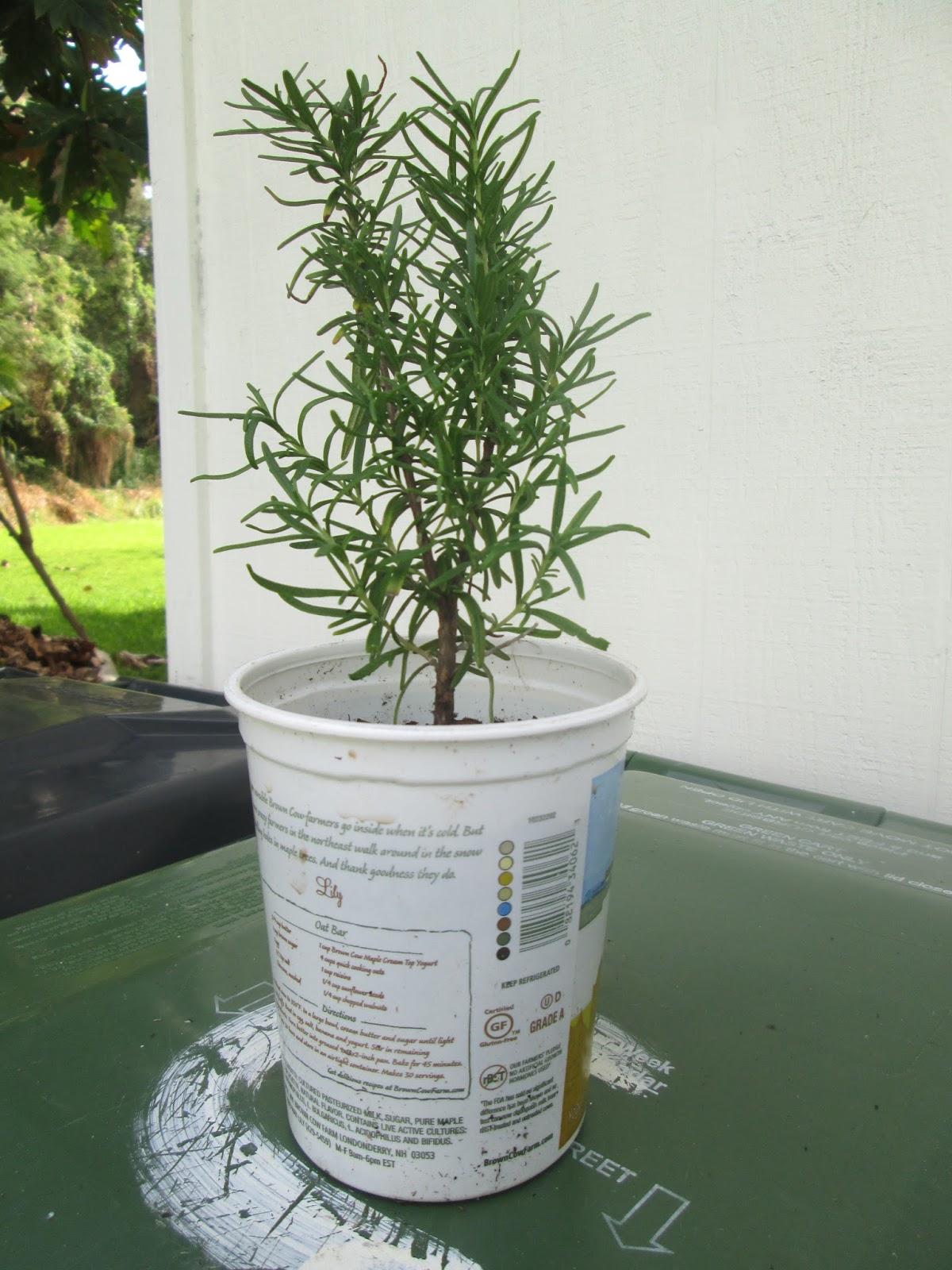
If I want to propagate some new Rosemary plants from cuttings I will first pinch the tips off all the young vertical stems on the mother plant.  Months later, when the the vertical stems now have branched out, I cut the stems off, remove leaves from the bottom few inches, and plant them up in a pot.  Usually I give the cuttings a few hours to perk up in water first and a dip in rooting hormone before planting as they are not easy growers and my sucess rate with Rosemary is not fantastic.  At least a few will root and live out of about a dozen cutting.  The new branching growth from the pinching of the tips gives the new baby plant a nice tree shaped growth.

Aloha

PS   Feb. 20017.
Recently read about a study that found that even just sniffing the scent of Rosemary can help your memory.  mmmm.   Well, if a free sniff of my Rosemary bush will help my aging little grey cells, I guess I can do that on my morning inspection walk around the garden.