Wednesday, April 30, 2014

Garden Arches in New Zealand


I am back home again after spending two months in New Zealand visiting relatives and playing tourist.  It was the end of their summer so many gardens there were not showing their best for photos.  One thing that I did love looking at was all the garden arches used there in home gardens.  They can be seen though out the country.  They are often simple home made structures, using 4"x4" and 4"x2" lumber, but really add to the character of the garden.  Others can be more expensive bought arches.  As I traveled around, I started to take pictures of them and I have put up several of them on the blog for you to have a look at and maybe be inspired by.  All of these pictures show the archway as part of the garden entrance way but they could also be freestanding.


A few years ago, after another trip to New Zealand, I decided that I wanted a Kiwi style garden arch in my garden here in Hawaii.  Living in the tropics, building wooden structures in the garden is just asking for a termite invasion.  I looked at the new recycled plastic pretend lumber and the new white vinyl fence material to see if that would work but it just did not look like the New Zealand wood arches.  Instead I decided to go with the more expensive redwood lumber which is a bit more bug and weather proof.  The wooden corner poles were not buried in the soil but attached to metal bases that were cemented into the soil to further keep termites away.  So far so good.  Here is a picture of my garden arch in the front garden.  I have a type of passion fruit growing on it....the sweet, orange leather skinned type that grows wild up in our mountains.  It never seems to want to climb to the top of the arch.  I think it knows there is too much salt wind up there.  Lower down it is protected from the wind by the surrounding bushes.


Aloha

Tuesday, February 18, 2014

MOA (Psilotum nudum)


I have an interesting plant that will pop up in odd corners of my garden.  Although it is considered a Hawaiian native, it is also native to much of the tropical world.  This plant is an unusual primitive plant called a Whisk Fern, or Moa if you call it by the local Hawaiian name.  The plant establishes itself from minute spores that float around in the air.  It will grow in most soils, sun or shade, even in rocky areas and up in the forks of the trees, so that it can be seen as a weed in both rural and urban areas.


Years ago I was inspired from seeing a large Moa plant in an attractive container at a flower show in Honolulu.  It has a strikingly different beauty.  From then on I never considered it just a weed in the garden.  I pulled up a few of the wild growers and potted them up in a nice cement container.  This I have placed by the kitchen steps where it gets the hot afternoon sum and where I enjoy seeing it every day.  It has proved to be a tough survivor plant.  It does get watered by me and I give it a bit of fertiliser occasionally.   About once a year I pull out any dead brown stems and also cut any stray ones off that are growing up from under the pot from the drainage holes.

Young green whisks of Moa


A small mature spray of Moa showing the tiny yellow sporangia.


As you can see from the pictures, it is not a big leafy plant but is formed by skinny stems or "whisks".  It does not have flowers but forms tiny yellow balls or sporangia on the stems.  In the old days, the Hawaiians used to gather these sporangia and pound them into a white powder that they used like talc powder under their malo (loin cloths).  I imagine a new tapa cloth malo would be a bit scratchy.  Today Moa is still used in flower arranging.  It is lovely mixed in with a small posy of flowers and gives added interest to a haku lei.

Aloha

PS  August, 2018
So....four years latter after writing the above post, it has become obvious to me that really, I have two types of Moa in my garden and that the green long one in the first arrangement is never going to look like the short one with the yellow bobbles in the second arrangement.   The yellow bobble one comes from the plant shown at the top of the post.

Tuesday, January 21, 2014

RED GINGER (Alpinia purpurata)


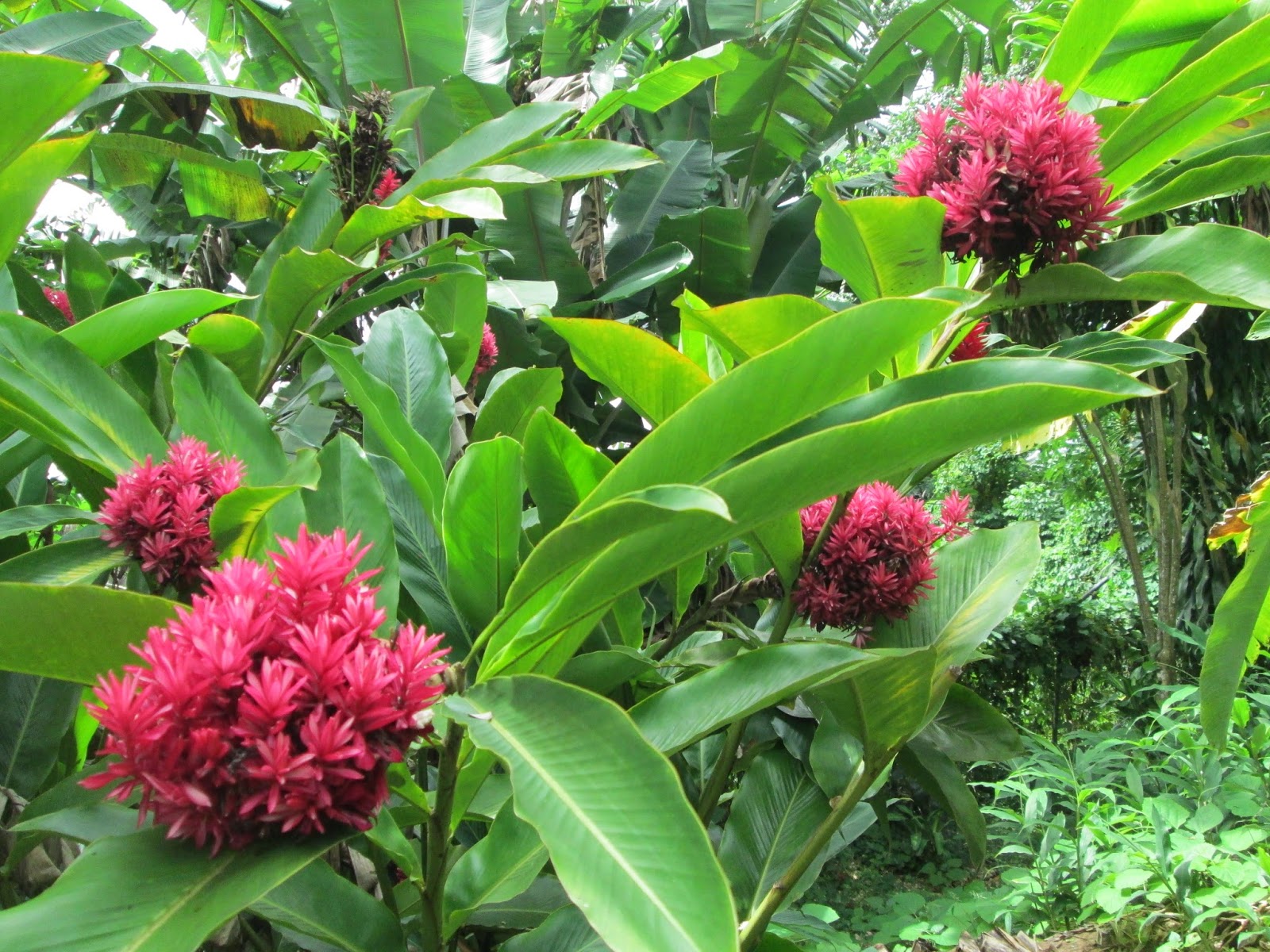
The Red Ginger is grown extensively throughout Hawaii and the other islands of the Pacific although it is a native of the Malaysian and/or Melanesian areas of the west Pacific.  I expect the flowers are sold throughout the world because they are a good long lasting tropical flower for the export trade.  Actually it is the bright red bracts of the flower that are the showy part.  The real flower is that tiny white flower you sometimes see peeping out from the red bracts.  Bundles of three or five flowers are commonly sold in Hawaii for putting on graves or to have in a vase in the house.  Of course they go well into big public flower arrangements too.  If you look at my blog for April 2012, you will see pictures of lots of Red Ginger being used in floral arrangements in Tahiti.  The red bracts of the flower can be pulled apart and the separate bracts used in lei making as well.


The Red Ginger is very popular in Samoa and has been taken on as a symbol of Samoa.  There it is called the Teuila and every year the country holds the Teuila Festival with lots of fun activities.  The plant grows well there in the hot and humid climate.  There is a very interesting note in Isobel Field's
1937 autobiography, "This Live I've Lived", about how she introduced the Red Ginger to Samoa for the garden up at Vailima and how it got its Samoan name.  Isobel was the step-daughter of the writer Robert Louis Stevenson who, along with his family, established a home in Samoa around 1890.  While there Isobel was given the name Teuila by the Samoans as she liked to beautify people and place.   To quote Isobel:

     "Believing that lovely flowering plant, the sweet-scented ginger, would grow at Vailima, I sent to Honolulu for some roots.  Soon they were blossoming everywhere, and the natives, admiring their perfumed beauty, paid me a pretty compliment.  To this day the sweet-scented ginger, that grows so luxuriantly in Samoa, is called the "Teuila flower"  I like to think of this, and that "my flower added a new fragrance to our dear Island."

As I have already noted, Red Ginger likes warm moist weather It likes full sun but will accept light shade.  It loves rich soils with lots of organic matter so give it lots of compost and mulch.  I have a problem with growing them in my garden because our sandy soil tends to make the leaves a bit yellow but the flowers still grow.  At my daughter's house they have a long line of Red Ginger growing along the side of the house where the rain falls of the roof.  It keeps the plants well watered without effort or cost most of the year.  Several years ago, I tended a  row of Red Ginger that must have been over 100 ft. long at least.  We left a soaker hose running through the plants which we connected up to the hose bib to water frequently......the water oozes out of the whole length of the hose.  Red Ginger flowers all year long but produces more flowers in the summer.  Giving a balanced fertiliser every few months will increase flower production.  Mature plants can grow as high as 10 ft. so keep that in mind when you place that small 2 ft. plant you bought from the nursery in the ground.  Red Ginger plants make a really good tropical screen for an ugly fence.

The one mistake that newcomers to Red Ginger make is in how they cut the flowers off.  Each stalk the plant grows produces one flower.  To harvest the flower or to trim of the dead flowers, cut the stalk at ground level.  If you cut the stalk half way down you will have ugly, and dangerous, sharp stalks with dead leaves left on display.  If you are harvesting the flowers to use in flower arrangements, the more stalk left on the flower the longer the flower will last.  The leaves are usually cut off the stalk with the top few leaves trimmed to make them smaller for better presentation.

There are many varieties of Alpinia purpurata.  The red flower is the most common but there is also a pale pink version.  In recent years, two other varieties have become popular in flower arrangements in Hawaii.  They are the Kimi, which is a fat pink flower with a lighter color center, and the Raspberry which is a darker pink and very attractive.  There is a Tahitian variety that you see often in Tahiti.  With this variety, the small flowerettes that can grow on the mother flower as part of vegetative reproduction form into a huge compounded flower the size of a football and looks spectacular in the garden.


young plantlet starting to grow on the old flower


plantlet and potted plantlets growing


Seeds are usually not formed in Red Ginger flowers although I have found some on the Kimi variety and have grown them.  The plant naturally produces by growing a plantlet on the mature flower. As the mother flower and stalk dies off the plantlet gets lowered to the ground, sends out roots and a new plant is grown.  To grow new Red Ginger plants, it is just a matter of collecting these plantlets and potting them up.  This is when you like lazy gardeners because if the gardener is diligent in keeping the plants trimmed and looking nice you are not going to find any plantlets growing on dying stalks.  The bigger and healthier the plantlet before you cut it off the better it will succeed in growing.  I usually stand the plantlets in water for a few days before I plant them up.  They do need to be placed in the shade while the roots get established and you will gets some dying of the leaves until this happens.  Then it is just a matter of watering and a bit of fertilizer to get the new plants growing to a few feet high and they are ready to be planted out.  It will take a year or so before the first flowers show up.  The adult plant can also be reproduced by dividing up the the rhizome base and transplanting them.

Aloha

PS  June, 2015

Here is a photo taken in Fiji of the Tahitian type of Red Ginger that develops big compounded flowers.


Sunday, December 15, 2013

PANDAN ( Pandanus amaryllifolius)


We have many kinds of big Pandanus trees in the Pacific Islands, so when I say I am using a Pandanus leaf as a herb or spice people immediately think of the 4 ft long leaves of the trees that are used to weave mats and baskets.......and they look at me funny.  I have to explain that Pandan is a mini sized Pandanus that would fit into their herb garden just fine.  A student from Malaysia introduced this plant to me and I have been growing it and using it for over ten years now.  It makes my common, California grown, rice give off  the lovely Jasmine rice smell when cooking and adds a nice subtle flavor to the rice as well.  Here in Hawaii, gourmet rices are becoming big time, with the rice shelves at the supermarket expanding greatly with all the fancy international choices.  Pandan makes my cheap rice taste like a gourmet rice.  It may be my imagination, but I think that the cooked rice does not go off so quick either if it has been cooked with Pandan.

The Pandan is a stalk like plant with long slender leaves of about 1- 1 1/2 ft. long.  After a while, the mature plant gives off little offshoots so that it becomes more of clump.  Mine has not grown higher than 3 ft.  As it matures, the plant bends down with the weight and sends out aerial roots to support it.  If you do not keep an eye on it, it could go expanding out in your garden so you do need to expect it to spread out somewhat.  However, if the clump is just taking up too much room, just break off some of the off shoots to give away as gifts or to root and pot up.  After about five years, I pulled up most of my Pandan and started again with  new rooted tops as the old clump was starting to look too messy and tangled.  I do love the fragrance of the Pandan in the garden on a humid or rainy day. 


The Pandan does not flower......an indication that this plant has relied on man to reproduce it for thousands of  years.  Pandan will grow in sun or semi-shade.  It does like moist soil.  I have seen it grown in swampy areas in SE Asia, but is grows in my sandy soil OK although I do water it every few days.  I notice my plants leaf tips get burnt when the salt wind gets going but otherwise it does fine.  It has no disease problems except that I notice that slugs will eat the tender leaves of the baby off shoots when I pot them up if I leave the pots sitting on the ground.

To propagate new Pandan plants I pull off an off shoot/sucker from the mother plant and leave it standing in water for a few weeks until it starts rooting before I pot it up.  I change the water daily to keep it fresh and oxygenated.  I found this worked better than just potting up the off shoot straight away where it tended to rot and die.

Pandan is commonly grown throughout SE Asia as a herb/spice.  As I said, I add my Pandan leaves to ordinary rice to give it a subtle Jasmine rice flavor.  I suspect I may be getting added benefits of some plant goodness into my rice as well.  Some in SE Asia consider the plant to have medicinal qualities.
If you are familiar with Nasi Lemak from Malaysia, this is just rice cooked with coconut milk and a few leaves of Pandan.  The usual method is just to cut three leaves of Pandan, tie them together into a knot and throw them in the pot with the rice.  This makes for easy removal at the end of cooking.  Do not use the white part of the leaf at the base.  Leaves do keep quite well in the refrigerator.  Wrap them up in a damp cloth or paper towel and store them in a plastic bag.

Pandan leaves for sale in a Thai market. 


You can buy bottles of Pandan essence in Asian stores.  They are usually bright green in color so I eye them suspiciously.  I think green food color has been added.  I ate Pandan bread  and Pandan mochi in Malaysia that was green in color.  To tell the truth, there was more green food coloring there too than any Pandan taste that I could detect.  In Thailand I bought small pieces of chicken wrapped in Pandan leaves and fried.  It was nice chicken but I could not taste any Pandan flavor.  More a unique way of presenting food.

On looking around the Internet I find recipes for making your own Pandan juice.  Just blend 6-8 leaves with 2/3 cup of water in a food processor and discard the solids to keep the liquid for cooking.  Or you can make a Pandan paste.  Boil 1" pieces of leaves in 1/2 a cup of water and then throw it all into a food processor and use the resulting paste to add to your cakes and desserts. This sounds better than buying those bright green bottles of Pandan essence at the store.   I think I will just be sticking to throwing a few leaves into my rice pot which has become a long time habit now.  Some Nasi Lemak goes over well too....

Aloha

PS   October 2019
I have been off traveling in Thailand lately.  I just want to add two photos of flower arrangements made by a lady there who was selling them for offerings at a temple.  In Hawaii people make similar "roses" out of lauhala leaves but this is the first time I have seen it done with Pandan.  Fragrant, pretty and very inspirational.

Flower arrangements based on woven pandan leaves

Posies with a white lotus flower added.


Friday, November 15, 2013

STEPHANOTIS VINE (Stephanotis floribunda)


Stephanotis, also called the Wedding Flower or Madagascar Jasmine, is another of my favorite useful and tough plants.  Of course, it is useful because of its fragrant, waxy white flowers that go so well in wedding bouquets and leis but the hardy plant is also wonderful in hiding all those ugly chain link fences we have in Hawaii.


The Stephanotis vine likes to grow in a sunny place with good soil drainage.  They just love chain link fences although they tend to favor the top of the fence so you may have to position and pinch the the young tendrils to encourage them to cover the fence well.  Giving the plant some fertiliser and water will give you a lot more flowers but the plant is a tough survivor once established.  It can tolerate salty ocean breezes.  The young plant does seem to take time to get established, so just keep watering after planting it with a bit of fertiliser and soon tendrils will start reaching up and it will take off.

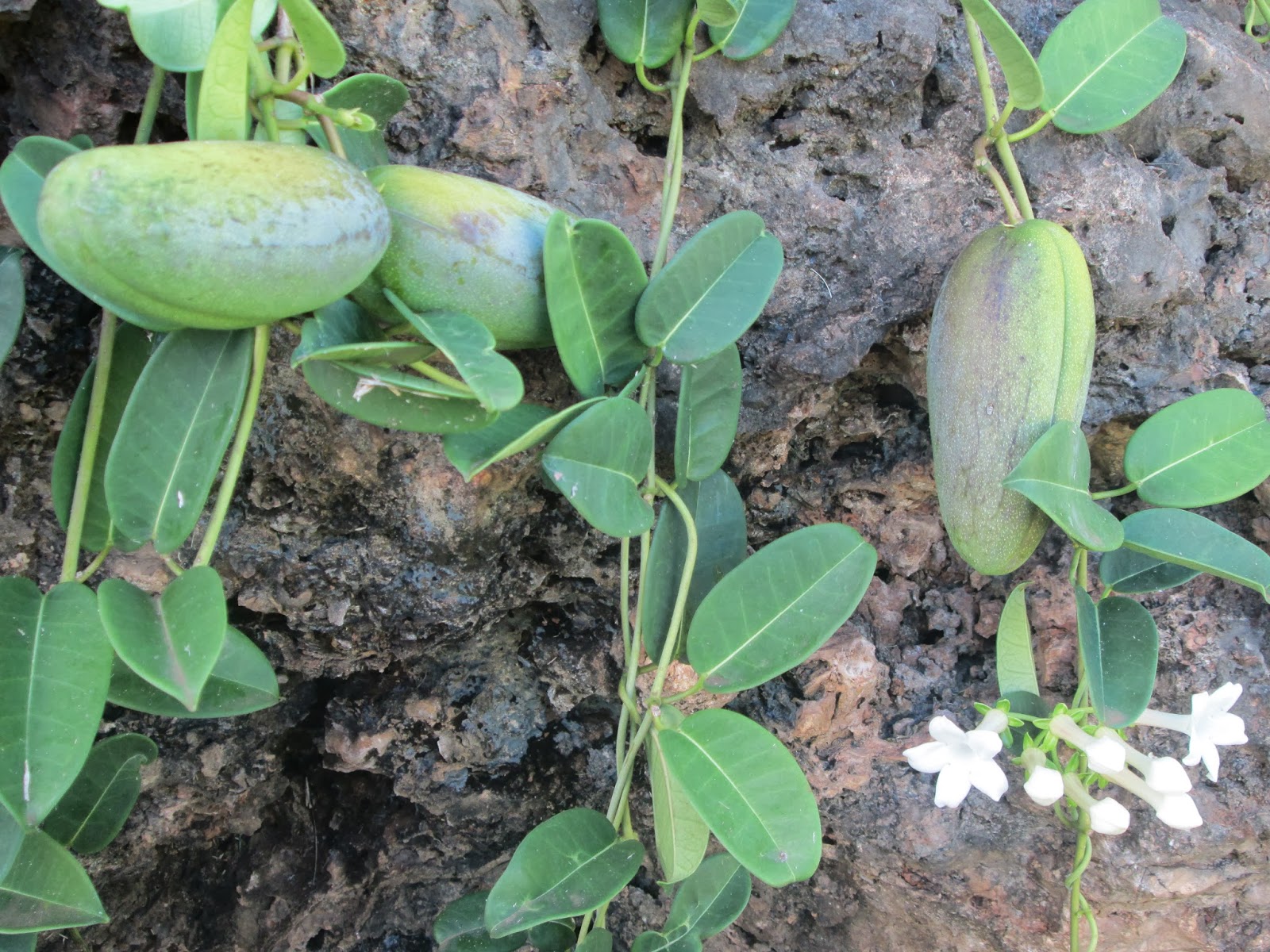
Stephanotis can be propagated from cuttings but I grow my plants from seed.  I pick one of the  large seed pods ( they look rather like a mango) when it is starting to turn from green to a yellow-brown and put it up on the kitchen window ledge until it fully ripens and cracks open.  Actually , it is a good idea to put a rubber band loosely around the pod so that the seeds cannot float off when you are not watching as each seed has a fluffy propeller like a dandelion seed so that it can be carried by the wind.


I always love my first look into the Stephanotis pod when it opens up.  It is one of the marvels of nature to see how the seeds and their unopened fluff is packed so beautifully into the pod.  One pod gives hundreds of seeds and they easily sprout into hardy seedlings.  These I transplant into plastic cups to get them rooted well before planting out when they start getting a tendril reaching up.


The Stephanotis flushes into flower in the spring and summer so it is good timing for bridal bouquets and graduation leis.  In bouquets, a floral pick or a bit of coconut leaf mid-rib can be used to position
the flowers.  The flowers string beautifully into leis or on knotted ribbon streamers.

Aloha

June 2026

Thirteen years later and my Stephanotis is still going strong. It liked all that Kona Low rain we had a few months ago.   It has been used for a few graduation lei again this year.


Monday, October 14, 2013

Container Plants at Biltmore


Well I have been off traveling in the eastern part of the US mainland for the past month.  I was not expecting to come back with garden photos for the the blog because I figured most gardens would by dying down for the winter at this time of the year.  The trees were just starting to get their autumn colors which is always so exotic to us tropics dwellers and I got all excited about seeing walnuts and chestnuts falling from the trees.

However, as you can see from the following pictures, Biltmore Estate gardeners still had things in full show in their containers around Biltmore House.  Biltmore is one of the few real grand houses of America and was built over a hundred years ago in Asheville, North Carolina by the fabulously wealthy Vanderbilt family.  If you ever get to visit this beautiful house, make sure you visit the Italian and Walled gardens that are at the side of the house.  I also really enjoyed the farm area as well.

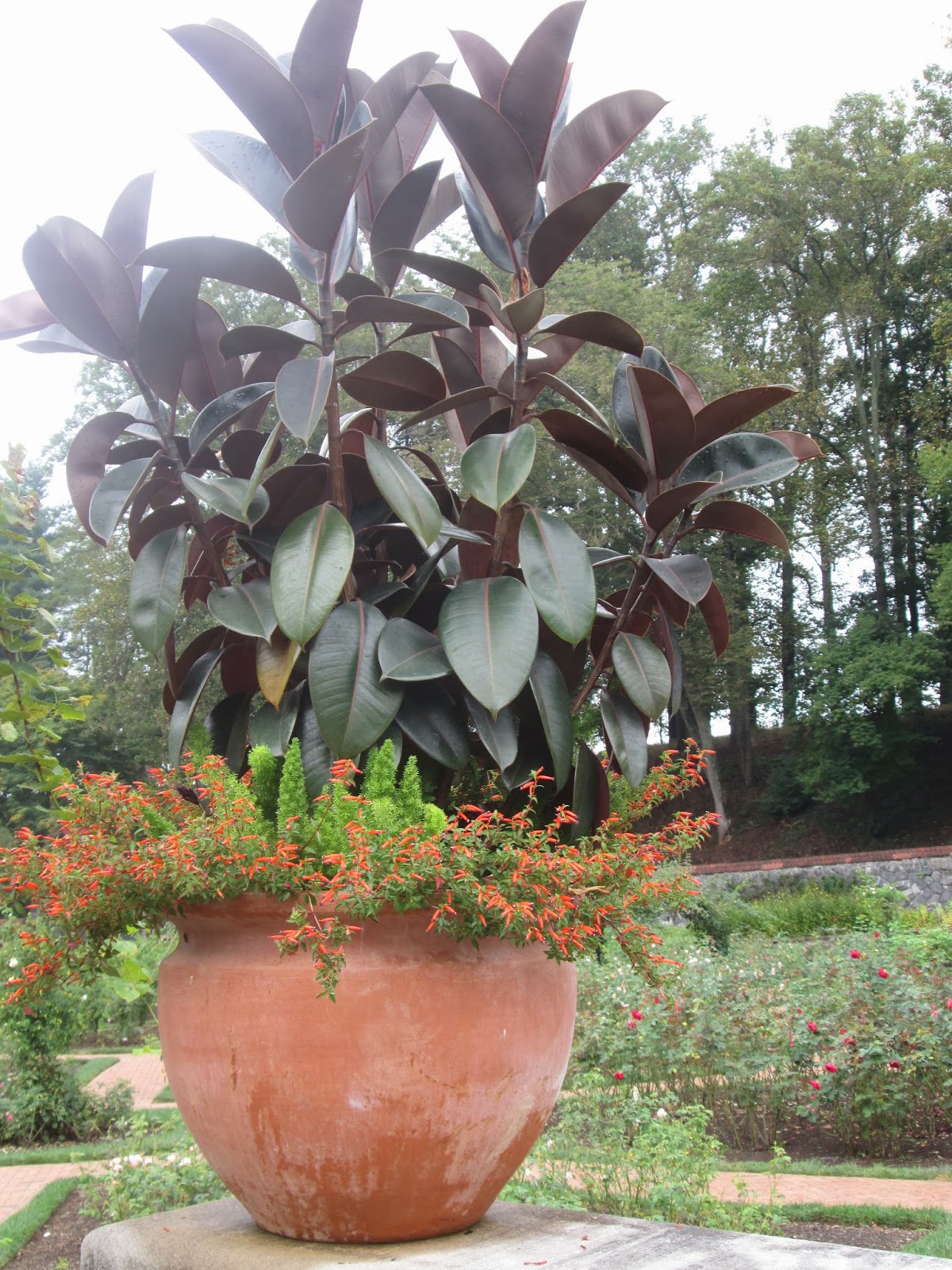
You will recognize several tropical friends in the following photos that seem to do well in the summer in North Carolina but I expect they get moved into a glass house for the winter.  I was surprised to see the variegated Hau (Beach Hibiscus) being used in a container but it really looked quite nice.  All the same, I am getting rid of it in my own garden as it has turned into a monster that I do not want to be hard pruning for the rest of my life.  Enjoy the following pictures and see how many tropical plants you can find in them. The last photo is not so much for the container but for the fantastic color and leaf combination of tropical plants.

Aloha

PS    A very good article about the Biltmore Estate and its food production can be found at:

http://www.msn.com/en-us/travel/article/a-thanksgiving-inspired-by-the-biltmore/ar-BBf8UNC


Friday, August 9, 2013

NEW ZEALAND SPINACH ( Tetragonia tetragonioides )


It is a funny thing, that even though I was born and raised in New Zealand, I never heard of New Zealand Spinach there.  It was not until I was living in the USA that I first heard about it and only saw it for the first time about twenty years ago when a local gardener here in Hawaii pointed it out in her garden.  I have gradually become more and more interested in this  plant and it is to be noted that I do see a few gardeners in New Zealand growing this plant now.

New Zealand Spinach  really became part of my life after I discovered that the plant has gone wild on the sand dunes in Hawaii, including along a few beaches near my house.    I can harvest big bunches of leafy tips and have nutritious greens for a stir-fry for free.  I must admit that it gives me great joy to gather free food from natures garden!  It is easy to recognize the plant in the wild because of its distinctive leaves and trailing habit.  It also has an easily recognizable tiny yellow flower and seed case.

Although there are a few New Zealand Spinach plants to be found near the beach all year long, the new seedlings really start popping up after the heavy rain of spring and fall.  I watch out for them on my beach walks and know where to go back to harvest in the next few months.  I usually cook the greens in a stir-fry with a bit of meat and seasoning.  The plants can be seen growing in full sun, but they do seem to do better with a bit of shade.  Often they will be growing amongst the fallen Ironwood (Casuarina equisetifolia ) tree needles while many other plants do not like the Ironwood leaf mulch.


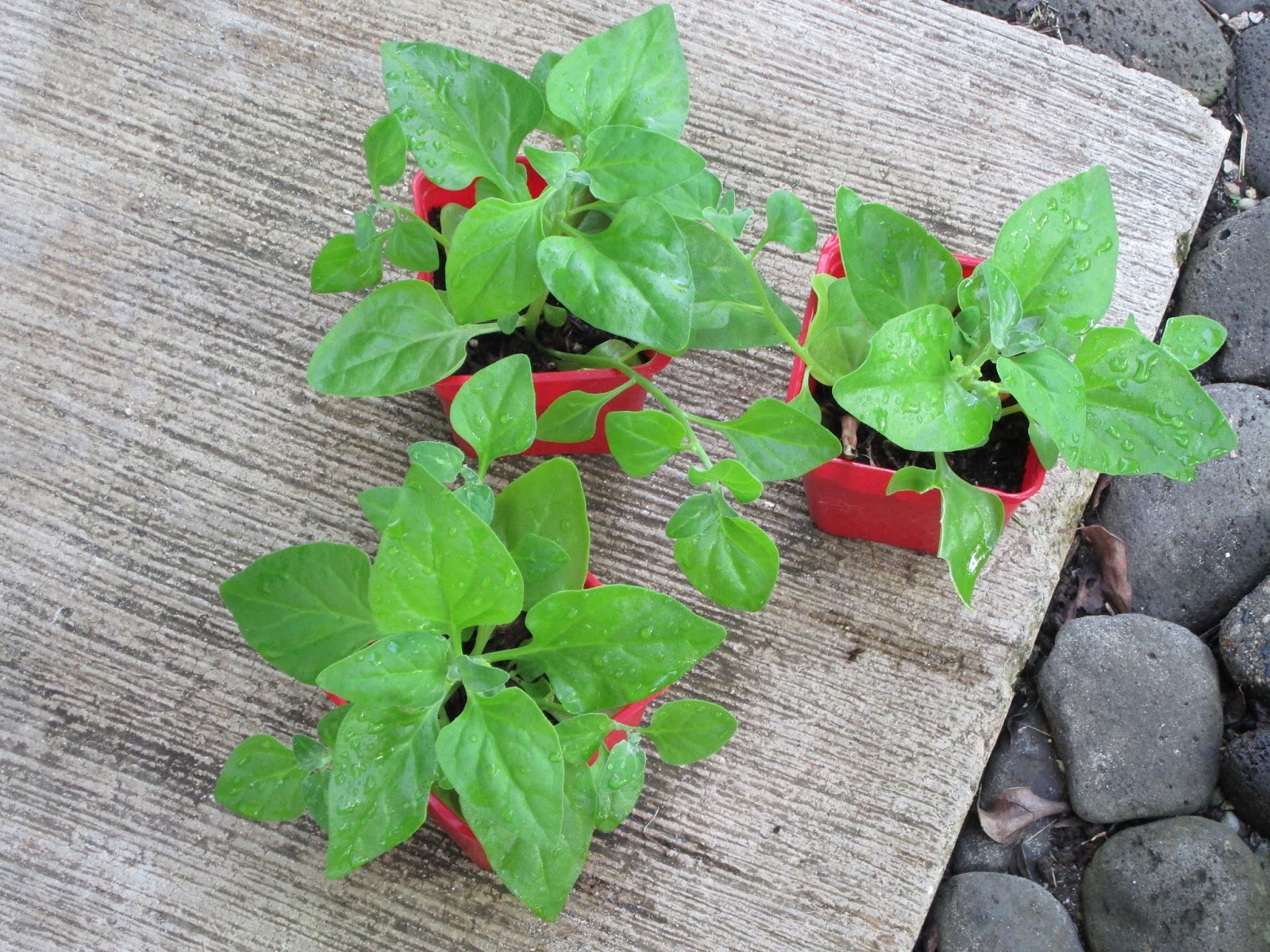
When the New Zealand Spinach seedlings are just a few weeks old, I gently pull up several small plants to take home.  After they have a few hours in a glass of water to perk them up, I pot them up in little 4" pots.  In a week they are rooted and strong enough to pass along to other gardeners to plant in their vegetable plots.  That is for gardeners who do not like the idea of free food from the beach!


New Zealand Spinach is another of my tough plants.  It does not mind our sandy soils, salt winds and hot summers.  This plant is native to New Zealand and Australia as well as a few other South Pacific rim countries.  The Maori people of New Zealand called it Kokihi and it is usually referred to as Warrigal Greens in Australia.  Neither the Maori of New Zealand or the Aborigines of Australia were into eating it much but the discoverer Captain Cook loved it as a green vegetable to give his ships crew to prevent scurvy.  It was Captain Cook who introduced the vegetable to the rest of the world.  The leaves are an excellent source of Vitamin A but it is another one of those green leaf plants high in oxalate so it is recommended to blanch the leaves in boiling water for a few minutes if you are worried about getting kidney stones.  Even if you are not into eating it, New Zealand Spinach, with its low trailing growth, makes a good hardy ground cover for sandy gardens.

Aloha

April 2026

Last year I was in the Azores and was surprised to see NZ Spinach growing wild there on the rocky coast near town.  It was also being sold in the towns produce market.


This has been a very wet winter for us in Hawaii.  As a result the NZ Spinach as just gone crazy down near our beach.....just huge areas covered in it.  Time to harvest while it is fresh.