Monday, December 15, 2025

SAN MIGUEL ISLAND IN THE AZORES

 A few weeks back I spent ten days on the island of San Miguel in the Azores on my way back from Portugal.  People in Hawaii feel a connection to the Azores as many Portuguese immigrated from there and Madeira to come work in our sugar plantations during the last part of the 19th century and early 20th century.  At that time sugar cane plantations were plentiful in both the Azores and Hawaii.  They are all gone now except I did see one small sugar cane plantation on San Miguel that supplies sugar for a locally made rum.  Because I live on an island, it is always interesting to compare life on other islands.  The Azores are very similar being  isolated volcanic islands way out in the ocean but are smaller.  I know Ireland gets called the Emerald Isle but I think San Miguel has even more right to that name.  All those volcanic cones and craters covered in green green grass and forest. It was a funny amalgamation of Savaii, Samoa volcanic horizons, with Taranaki, New Zealand dairy farm views leading to Portuguese towns.  I was very impressed with how self supporting the island was.  They are now looking for economic support from tourism but there is a big agriculture backing for it.  The dairy farms provide the milk, butter and cheese.  Bananas, pineapples and vegetables are all grown locally.  There is even a small tea plantation. Of course there is local fishing as well.  I was also impressed that 60% of the power on San Miguel comes from volcanic steam driven turbines. Several people from there told me how they felt they had everything they needed despite living on a small island....that the needed facilities for business, health, transport and education, etc. were available there for them.  The small capital city of Ponta Delgada was a delightful place to have as my base while I was there.  Lots of atmosphere walking the narrow cobbled streets of the old town or along the water front.


I was surprised to see these NZ pohutukawa
trees along the Ponta Delgada waterfront.


Flowers in the plaza in front of Ponta Delgada City Hall


The lovely botanical park at Ponta Delgada


Plane trees pruned back for winter in a plaza in Ponta Delgada


A park in the middle of the city next to the library.
It seemed to be the teenage hangout in the evening.


Another surprise!  New Zealand spinach growing wild on the 
sea shore.  I also saw it being sold at the produce market.


Farmland inside a volcanic crater


Taro farm at Furnas...another surprise for me. 


Pineapple is grown inside glass houses on small farms.


The Azores farmers are very proud of their sweet pineapple.
They say that pulling out the long leaves from the top of 
the pineapple helps to make the fruit sweeter.


The Azores variety of banana....short and stumpy.


Hydrangeas are everywhere on San Miguel.  Used as 
hedges but they have become a big part of island culture now.
Unfortunately I was there just as they were finishing their show.

Aloha

Friday, July 25, 2025

RLS MUSEUM, VAILIMA, SAMOA

 Robert Louis Stevenson, the well known Scottish author (known as Tusitala in Samoa), found Samoa to his liking while traveling around the islands of the Pacific.  He ended up living there for the last five years of his life.  Stevenson and his wife Fanny built a large home and plantation up on the slopes of Mt Vaea....about 5 km above the main town of Apia.

100 years after his death the home of RLS was turned into a museum with a small paid entrance fee.  The surrounding land is now a free access National Reserve and includes a botanical park and a forest hike up to his grave on the mountain.  I was pleased to revisit the house this past month and to explore the gardens.  My old knees prevented me climbing up to his grave to pay my respects and see the view but I really enjoyed wondering along the lower paths through the forest from the house and carpark.  There is even a little pool in the stream where you can have a cooling swim after your hike.


Front entrance to house.

The driveway up to the house.

The house.


A silver pseuderanthemum..my
first time seeing one.

The cookhouse?  out back.

In the lower forest area.

Lower forest walkway to house.


Aloha

Thursday, June 19, 2025

RUELLIA (Ruellia simplex)

 Mmmmm......just noted that I have only done two blog posts so far this year.  Sorry folks......I guess I am slowing down with age.  I will try and keep the occasional one going.....good for my little gray cells and hopefully helpful or entertaining for you.


Ruellia has really only just showed up on this island in the last few decades.  This purple flowered plant seems popular as a colorful, quick growing plant to grow by food trucks.  This tells me it is an "easy to grow for free" plant that will grow quickly from cuttings.  I have yet to see it being sold in nurseries.  I got some cuttings a few years ago to plant in my garden so that I could get to know the plant.


A patch of Ruellia used in street landscape,
Chinatown, Singapore

Ruellia is native to Mexico and Central America.  Already it is on my tough plant list.  Back home it likes to grow along moist lake edges etc.  In that situation it can really spread easily and become invasive so I do not recommend growing it in any wetland situation here.  On the other hand, because it is so tough, it will also grow in dryer conditions and can make a nice addition to your garden if grown in the right place and you monitor its spread.


Ruellia grows about 2-3 ft tall with dark green lance shaped leaves and with sprays of purple flowers.  These flowers only last one day....blooming at dawn and dropping off by mid afternoon.  I have a few flowering plants like this in my garden.  I joke that if I were to hold a garden party, it needs to be in the morning.  The long stems of the Ruellia  are very sturdy so that is makes attractive and long lasting greenery in a large flower arrangement as long as you do not mind having no flowers showing in the evening but new flowers coming out each day.


A stem that I have had sitting in this
bottle of water for a few days.

The natural growth habit of the plant is for the long stems to lie down on the ground and new plants to grow up from the nodes.  It is very easy to grow new stems from those new young stems.  You only need to put one plant into your garden as in several months that one plant will have "walked" and give you a spreading plant of  several heads.  You will need to decide how far you will let it spread and trim off those walking stems if needed.  I have seen it grow into a very compact clump in a restricted space....this can become too compacted over time so that the clump will look better thinned out with your hand pruners.  I have seen people even just cut the whole clump down with a hedge trimmer but in most cases this does not look very attractive.  This is a good time to cut a bunch for a vase in your home.


Easy to snip a few cuttings of this stem.

It is also a good tough plant to try growing in a large container on your lanai.  It does prefer sun but will do fine in semi shade.  I see on the internet that there are a few different cultivars of Ruellia sold at nurseries on the mainland.  There is a pink variety that I first saw growing in Sri Lanka a couple of years ago.  The internet also says it is a self seeder but I have never seen seeds or volunteer babies from it.  Has anyone in Hawaii?  Maybe the plants we have in Hawaii are from one of the seedless cultivars.  The bees do like the flowers.


Aloha

PS 

July, 2025    Use of Ruellia along the roadside in Savaii, Samoa.


Nov, 2025

So......a problem has shown up with this plant.....I first thought it was just in my garden but now I have seen it in others in my town.  Some sort of bug is causing ugly white markings all over the leaves.  I have been googling it and it looks like it is some kind of mite that causes the leaf to go this way as a reaction to the mite.  I cut the affected parts off but it looks like it comes back again later.  Maybe soapy water spray will help but do I want to bother with that. Not sure if I will be keeping this plant in the garden or not.  Will observe what happens over the year.....does it stick around for ever or just a few months of the year.  Anyways ...here is a picture of the affected leaves.


Saturday, March 29, 2025

A WEEK IN AUSTIN TEXAS

 I have just come back from a week in Austin, Texas.  This was my first trip to Texas so I was eager to see what it was like there.  I have long known Austin as a college and music city but now I know it has also become a big IT hub with many recent sky scrapers shooting up.  I wondered if I might see the famous wild flowers of Texas; so advocated for by Lady Bird Johnson.  Unfortunately, central Texas was under drought conditions, so no Blue Bonnets were to be seen along the country roads but I did get to see some close up at the lovely Zilker Botanical Park.  You can catch a city bus there from downtown.  I did see several Texas Red Bud bushes in flower so  there was some evidence of spring arriving.  The biggest green area of the city is along the banks of the big  Colorado river that runs through the city. ( Not to be confused with the other Colorado river further west.)  Lots of trails for runners and dog walkers.  I also saw a few new native plant gardens along the way......with names of  the donors who cared about their community.  Another green walkway is going up along the Waterloo stream that runs from the University of Texas down to the main river.  The upper part looks a bit neglected but hopefully will get fully used when connected to the lower paths that are still being constructed.  I saw a few herons fishing in that stream.  Another green area is around the state capital and tourists were making use of the shady tree area.  Lastly......I fell in love with the live oak trees of Texas.  Such beautiful bark on the trunks of older trees and  then the bare branch outlines against the sky with their tufts of Tillandsia.  The live oak mixed with pine forests were so beautiful too out in the rural hill country.  A lovely memory of my short trip to Austin.


Texas Red Bud in flower with the state capital
building in the distance.


Gardens and walkways besides the Colorado river.


The famous Blue Bonnets of Texas.


A short walk in the woods at the Zilker Botanical Park.


Hill Country views.....woody fields and vineyards.


Beautiful old Live Oaks.


Live Oaks with Tillandsia balls in situ.


A modern style garden at one of the new condo buildings
built for all the new IT workers.


I passed this house every day.  An old timer tucked behind a 
restaurant and overlooked by skyscrapers.   Not much of a 
garden but every time I stopped to watch the squirrels and the
birds. ( Great-tailed Grackles and White-winged Doves)


Aloha

Wednesday, February 5, 2025

GINGER ROOT (Zingibier officinale)

 Winter has arrived in Hawaii so it was time to harvest my Ginger a few weeks ago.  I was pleasantly surprised with the results....so much Ginger in fact that I was able to share with my kids and a few Chinese cook friends.  Just in time too, to make hot lemon Ginger tea that is so nice on cold winter evenings.  I have attempted to grow Ginger in 10 gallon pots a few times in the past without much success.  Now I am growing it in a 3 ft. wide, low tub with lots of compost which seems to work out much better.  It is a learning process and I still have a few new tricks I want to try out this year.


Mature plants


Ginger has been used for cooking and medicinal purposes for at least 4000 years in Asia and now used around the world.  I suspect that the Dutch had a part in giving us powdered ginger for baking from their colonies and taking Ginger beyond its root form.  Growing up I only knew Ginger as a spice powder to add to cookies and gingerbread.  It took adulthood and living in different countries to make Ginger root part of my regular cooking.  I tend to do most of my cooking on the stove top which means lots of stir fried vege and meat dishes.  Minced garlic and Ginger root are always part of the deal.  I keep most of my Ginger in the freezer and just chop or grate what I need off the frozen root piece. Ginger root will also last fresh in the fridge for about a month if kept in a paper bag.  Ginger root sells at my local supermarket for $5 a pound, ($3 in Chinatown), so it gives me some satisfaction to grow my own.


Young ginger rhizomes growing 


To grow Ginger you just replant some of the harvested root....actually it is technically a rhizome and the real roots grow off it.   You can  break it into small pieces of just a few inches if you like as long as there are a few "eyes" or nodes on it which are the points of new growth.  However, the bigger the piece of Ginger you plant, the bigger the Ginger "hands" that you will harvest.  It takes 8-10 months for the Ginger rhizomes to be really big enough for a good harvest.  If you are going to replant some of your harvested rhizome, give it a few days first to dry out and make protective scars where it has been broken or cut to prevent it rotting in the soil.  You can also have gardening fun with a piece of Ginger root from the supermarket which will grow just the same.  Look for a nice plump hand of Ginger and then soak it in water for a day first to get it hydrated and to remove any growth inhibiter that may have been used on them.


Ginger flowers


Many, who live in the tropics, leave their Ginger patch to just go on growing rather than harvesting the roots when the leaves die down in the winter as they do on Ginger farms.  The rhizomes can be dug up and used as needed at any stage of the growth through the year. (One of my sons had a Ginger emergency a few months ago and we were out digging for some late at night)  I would make sure that the Ginger is getting some feeding like compost or fertilizer though to prevent it from using up the energy stored in its own rhizomes.


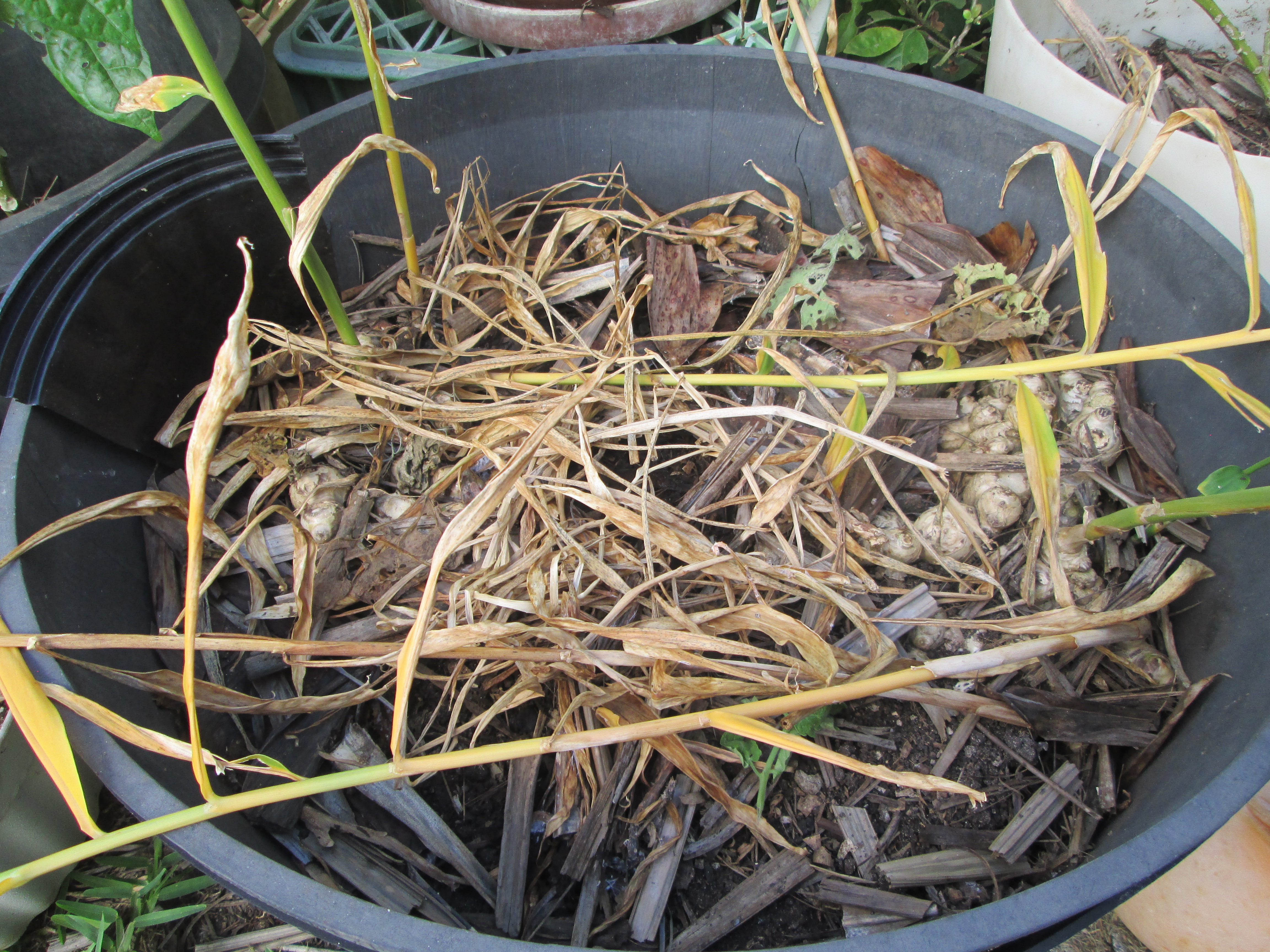
Ginger plant going into its dormant stage.


Ginger plants go dormant from October to March so it may be awhile before you see the green shoots come up from the planted roots.  For the same reason do not worry about the leaves turning brown and dead looking in the fall.  It is all part of the plants life cycle.  Ginger leaf stalks will grow 3-4 ft. high and a knobby green flower will also grow on a stalk up from the ground.  The flower only grows a foot or so high and gradually turns pink. The root clump can grow 1-2 ft. wide so it needs some space.  They love rich, well drained soil that gets compost added.  They also need warm, humid weather and prefer partial shade.


Mature ginger rhizomes ready to be dug up.

This past year I have kept my tub of Ginger well mulched and I also added extra compost.  Next year I am going beyond that by making an at least 7" trench to plant the rhizome piece in and then will  gradually hill up the soil over it as it grows over the next several months.  This is after watching a very impressive video on You Tube of a farmer in Asia planting her field crop in 12" trenches and by the end of the year the Ginger is growing out of rows of hills.  Apparently the rhizome will keep growing up and up as the soil is hilled and that is why you get those big long fresh ginger rhizomes you see sold at Costco rather than the chunky shaped ones that come out of my garden.  We will see how it goes.  It is also important to not overwater when first planting to prevent rot.  (Which makes me a bit concerned about all the rainy weather we had after I planted my last lot.  I will be waiting anxiously for those first green shoots to come up.)


The Rewards

Although not high in vitamins and minerals, Ginger contain gingerols that are not only tasty but beneficial to our health.  Gingerols can help reduce nausea so can be helpful for pregnant women or people on chemo, etc.  There is also evidence that ginger helps insulin resistance and the resulting non-alcoholic fatty liver,  Ginger is known as an anti-inflammatory food that is helpful against arthritis etc. but it's cousin Turmeric is even stronger for that. 

I have fun with cooking Ginger in stir fries and making Ginger tea.  There are lots of other Ginger things that can be a kitchen experiment if you want to take it to a higher level.  You Tube is your friend and teacher on how to do that.  How about drying the root and making your own Ginger powder for baking?  Or how about candied Ginger, which I associate with Christmas, or pickled Ginger to go with your sushi?  Home made Ginger beer could be a lovely option too!  Hmmmm.


Aloha